Oct 30, 2026  ·  4 min read

Coding agents were built for engineers. Turns out they work for everyone else, too.

Built for Engineers

Coding agents like Antigravity write code, run it, read the error, fix it, and try again. They keep going until it works.

For software engineers, the value was obvious from day one. More code, shipped faster, with less grind.

That was the expected part.
Then Everyone Else Showed Up

The loop that fixes code works on any job that runs on data. That's nearly every job.

Take Maria. She manages a roofing distribution branch in McKinney, Texas. She doesn't write code and has no interest in learning.

But the morning after a hailstorm, her job is a data problem. Storm reports, the CRM, the ERP, an inbox full of orders, and voice memos from contractors standing on damaged roofs. Pulling it together used to take her whole morning.

She never sees the code. She sees the answer.

Monday After the Hail

Maria asks three questions in plain English. For each one, the agent quietly writes the code to answer it.

She asks

Who's hit?

It joins hail reports to her contractors by ZIP code and ranks them by damage and open pipeline.

She asks

What do they need?

It reads roof photos, listens to voice memos, and parses emails in English and Spanish to build one order book.

She asks

Where's the stock?

It queries the ERP, finds the shortfall, and plans transfers from sister branches.

Why a Coding Agent, Not a Chatbot

A chatbot can tell you what to do. An agent that calls fixed tools stops the moment one of them breaks.

And enterprise systems break all the time. An ERP upgrade renames a field, or a unit switches from bundles to squares.

A coding agent reads the error, checks the new schema, rewrites its own tool, and runs it again. Maria never files a ticket. She never even knows it happened.

Agents used to call tools. Now they write them.

Built for One Person, One Morning

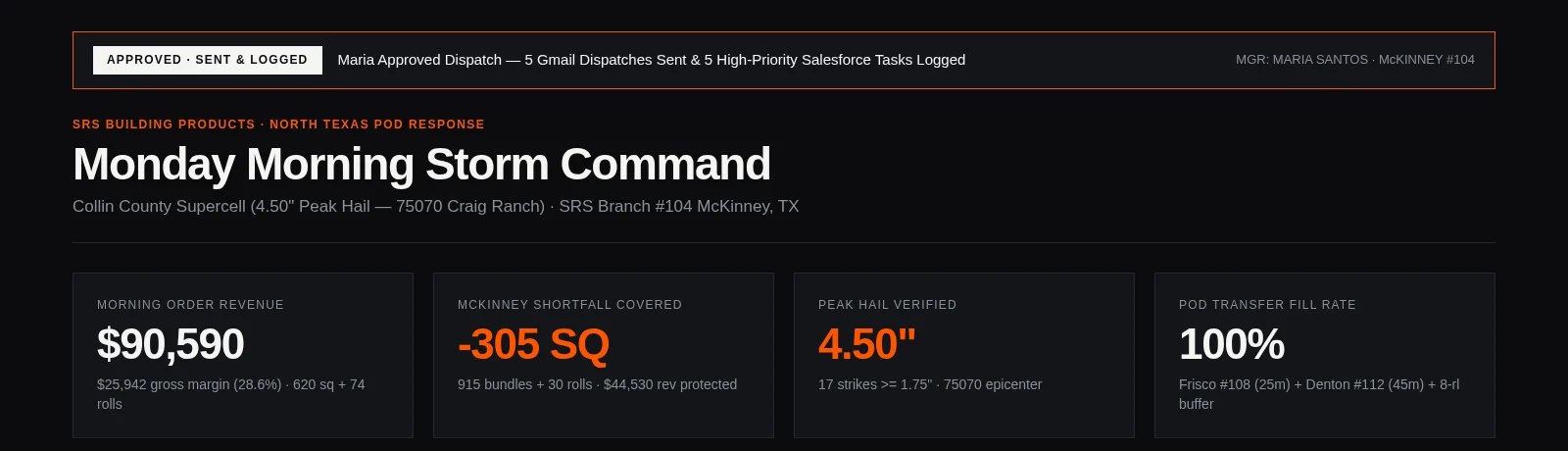
Maria asks for a storm-response page: the hail map, ranked contractors, stock against demand, and replies drafted in each contractor's language.

No vendor sells that, and IT would never prioritize it. The agent builds it in minutes. When software costs almost nothing, a single morning is reason enough to build it.

Nothing goes out until she approves it. Then the emails send, the transfers dispatch, and the CRM logs the follow-ups.

Storm-response dashboard showing $90,590 in morning orders, a 305-square shortfall covered, 4.5-inch peak hail, and a 100% transfer fill rate
Built by a branch manager who doesn't write code.

6:00 to 6:12. That used to be Maria's whole morning.

The Storm That Didn't Hurt

That's the agent assisting. Next it acts, and then it anticipates. Prompts become triggers, and people review the results instead of running every step.

Same branch, same storm, 72 hours earlier. At 2:00 AM on Friday, a nightly agent sees a 68% chance of large hail over McKinney. It moves stock in from sister branches, pre-clears contractor credit, and drafts customer alerts.

Nobody wakes up. If a system changed overnight, it fixes its own tools and keeps going. Then it stops at the edge of its authority.

Autonomy Needs Brakes

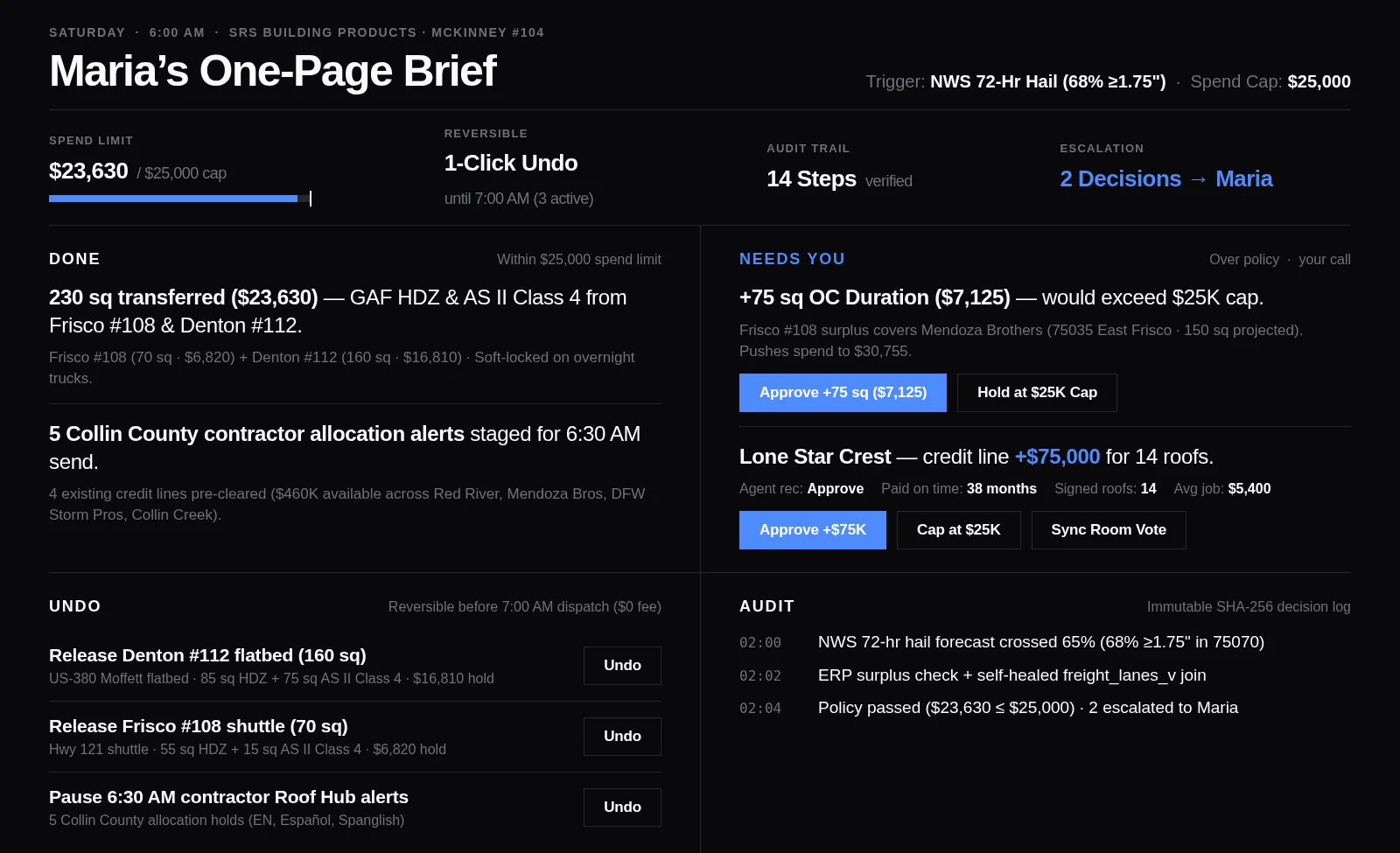
At 6:00 AM Saturday, Maria gets one page.

Done

Inside the spend limit

Already handled. $23,630 of a $25,000 cap.

Needs you

Over the limit

Sent to a person, with the agent's recommendation and the data behind it.

Undo

One click

Every action can be reversed until the trucks roll.

Audit

Every step

Logged, hashed, and explainable after the fact.

Maria's one-page brief with Done, Needs You, Undo, and Audit sections and a $25,000 spend cap
Done. Needs you. Undo. Audit.

Where the agent stops is a business decision, not a technical one. When I put one of those escalations to a room of executives, 32 of 50 approved it and the rest held. Both answers are reasonable, and that's why the escalation exists.

On Monday, Maria's branch is the only one with stock. Her contractors win the jobs.

Every Manager Gets an Engineer

Coding agents didn't stay with engineering. They're turning up in branches, warehouses, and back offices, wherever someone has data and a deadline.

Operators

Software on demand

The tool your team needs this morning gets built this morning, by the person who needs it.

Owners

A new 100-day plan

Value creation moves from software projects to agents in every function. Here's the plan.

Your data used to be the moat. Now it's how fast your people turn data into action. Soon it's how fast your agents do it without them.